|
|
A Tibetan Terrier's Story
|
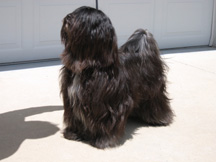
I have a Tibetan Terrier who recently (at age 2 1/2 years) was diagnosed with renal disease. I was puzzled by the diagnosis in such a young dog. She has always been a BIG water drinker, but I never realized how out of proportion her drinking was until I started measuring her intake and eventually compared it to my other TT's typical intake. She had been having sporadic accidents in the house, urinating very dilute urine. I took these incidents as lapses in housetraining. (Over the years many TT breeders and owners have expressed frustration from time to time citing house training difficulties with their TTs, so I was not overly alarmed.) I initially took my dog to a local vet to rule out any existing physical problems which might be causing accidents in the house. The vet remarked on her dilute urine, but he found no infection present and thought she might simply be a psychogenic drinker. When the problem persisted, I took her down to a vet I used to work with years ago in Phoenix who has an excellent small animal practice. We tested the urine and found no evidence of infection, but once again, her urine was very dilute. We repeated the tests a few months later when I took her in to be spayed, all with the same results. After a 12 hour water deprivation test, my dog had a specific gravity of 1.010 and her PCV (packed cell volume) was 68%. She was very dehydrated, yet she was continuing to produce dilute urine! Other tests were not indicative of Cushing's or Diabetes. At that time we also did an ultrasound which showed that one of her kidneys was quite small. My vet declined to go ahead with the spay, indicating that my dog had a poor prognosis long term due to renal disease. A vet tech/dog friend brought up the question of Juvenile Renal Dysplasia (JRD) and told me about a friend of hers who had recently lost a Dobie to the disease. The word juvenile in the disease description is somewhat misleading as many dogs do not show symptoms of the disease until they are adults. I began to wonder if my dog might be affected by the same disease Ü the symptoms my friend shared were very similar to what we were observing. I discussed the possibility with my vet who told me that the Tibetan Terrier breed was one of several breeds identified in veterinary journals as being associated with Juvenile Renal Dysplasia. However, at that time, the only way to definitively diagnose JRD was via invasive wedge biopsy of the kidneys. Wedge biopsies for JRD may help in identifying disease severity in certain individuals. I wasn't sure I wanted to do the surgery since my dog was not going to be used for breeding, a biopsy would provide no information to benefit her, and knowing the results would not change her prognosis. As I searched for answers, JRD information and citations from friends and acquaintances began to trickle in slowly. From an overseas breeder I found out that the occurrence of Renal Dysplasia was investigated in nine different breeds in Sweden during 1981-2001. The highest prevalence for that time period in order were as follows: Shih Tzu, Tibetan Terrier, Lhasa Apso and Tibetan Spaniel http://www.uppsatser.se/uppsats_0/01f96036f7.php. Tibetan Terriers ranked higher in incidence than Lhasas! I wrote to the Swedish Kennel club and asked them if they had a published list of affected TTs which they dutifully shared with me, however I could find nothing further about the disease in TTs living in the United States. My dog was happy, she ate well, acted normal (except for her water intake and the accidents in the house) and I began to wonder if our assessment of her was in error. None of the breeders I spoke to mentioned ever having a related problem. Their dogs all were outwardly healthy, and that underscores why this disease goes undiagnosed. Most dogs with renal dysplasia are diagnosed in the mild category (which is GOOD news for everyone) and they appear to be non-symptomatic - living, relatively normal lives. Some moderates exhibit slight symptoms and may die earlier than normal. Dogs that are severely affected often die young. Most dogs brought into animal hospitals with renal disease are supported symptomatically and are never biopsied, so it would follow that even if they have renal disease, they are not diagnosed with anything specific. Juvenile Renal Dysplasia is hereditary in Lhasas, Soft Coated Wheaten Terriers, Poodles, and Shih-Tzu (among other breeds) and those breed clubs have worked to identify the genes responsible for the disease. Molecular biologist, Dr. Mary Whiteley, has developed a genetic test to identify the mutation causing JRD in Tibetan Terriers through Dogenes, Inc. According to Dr. Whiteley, This mutation has absolutely been shown to be the cause from extensive pedigree studies in the other breeds, and there is no reason based on the clinical and pathological description of JRD in Tibetan terriers to think that this is not the cause in your breed. Although the impression may be that this disease is not prevalent in your breed, this may not be true as many people are not aware of this disorder. Education is key. Dr. Whiteley says, The test is 100 % accurate for JRD. The test is more informative than a wedge biopsy. Even animals that have a negative biopsy can produce JRD puppies with a positive biopsy, because animals that carry the mutation can be apparently normal, and produce affected offspring. JRD is inherited as autosomal dominant with incomplete penetrance, meaning that an animal with the mutation may or may not show signs of the disease. The DNA test tells you exactly what you are dealing with. This is why in the past that trying to eliminate this disorder by wedge biopsy, has failed. With a DNA test, you can breed to appropriate partners to get rid of the mutation entirely, and therefore you eliminate the disease from your kennel. I have just submitted test samples on my own dog to Dogenes, Inc. The sample gathering is easy, non-invasive and presents no risk to the dog. The owner uses small brushes to collect epithelial cells from the mucous membranes between the inside of a dog's cheek and the gum. The brushes containing the samples are then returned to Dogenes for analysis. My dog's test revealed that she is homozygous for the mutant allele. I have received wonderful support from friends and the Tibetan Terrier Club of America as I endeavor to make sense of all this. In addition, I have been in frequent contact with Debby Rothman (aka The Lhasa Lady) who did groundbreaking work on this disease in Lhasas when she discovered it in one of her own dogs. Her personal journey was not an easy one. She wound up biopsying approximately 62 Lhasas (before the development of a genetic test). The majority of those dogs were JRD affected. She has essentially rebuilt her entire breeding program. She is well respected for the contributions she has made on behalf of Lhasa Apso health. I am grateful for her help and encouragement. I am happy to finally have some answers to my dog's health puzzle. She continues to do well and we have started Rally training. Her condition may remain stable for years. I encourage other breeders/owners to test for the JRD mutation in their breeds and take advantage of this health screening tool. |
|