|
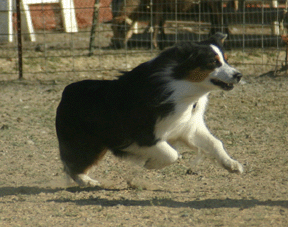
My husband, Alan, and I
first saw Major, Windfalls Major Babe, for the first time in March 2003. H was 10
months old. We had gone to our breederÕs looking for a dog we could show to
a championship in addition to competing in obedience and earning herding titles.
It was love at first sight.
When Major saw us, he was jumping up and down and twirling in mid air out of excitement.
IÕm sure you Aussie owners know what that looks like! WeÕd brought
Chance, our 1-1/2 year old neutered male Aussie with us to be sure the two would
be compatible. No problem, they got along perfectly. Of course we took him home with
us - not only was he beautiful, he was sweet.
We let Major grow up and settle in before we hit the show ring. He was shown exclusively
by junior handler Gina Stubblefield in Australian Shepherd Club of America events
and he earned his ASCA championship at 20 months of age with a 4-point and three
5-point majors after only a month of competition. With limited showing, he became
a multiple BOB/BOS winner and qualified for the Conformation Invitational at the
2005 ASCA National Specialty. With very little obedience training, he earned his
American Kennel Club Novice, Advanced and Excellent rally titles and International
Championship the same year. He went on to finish his AKC championship in 2006 with
multiple BOB/BOS wins, handled again by Gina and by Debbie Pollard. We started him
in herding and he showed a lot of promise; we hoped he might someday earn a WTCH.
Then, in October 2007, his herding and agility career came to an abrupt end. He was
only 5 years old.
Major had always been healthy and in fantastic condition. Alan played ÔChuck-itÓ
each morning with all the dogs for 30 Ñ 45 minutes, in addition to all his
other dog activities. But in July 2007 we noticed MajorÕs back seemed to be
hurting him. We took him to a vet that specialized in chiropractic and acupuncture
treatments. The treatment made him feel better and he was soon back to his old self.
A month later he was sore again, so we took him back. Once again, the treatment appeared
to help. The vet recommended we have a cracked tooth pulled as it was beginning to
abscess. We made an appointment for the following week.
We dropped Major off in the morning for what we thought would be a routine tooth
extraction. A couple hours later we got a call: They couldnÕt pull the tooth;
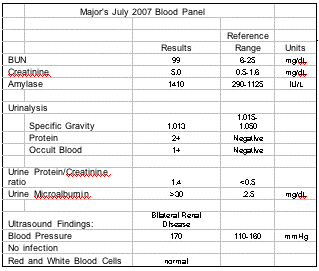
his pre-anesthesia blood panel showed him to be in early renal failure.
We were in total shock Ñ this must be a mistake! Here was a dog that appeared
totally normal. Common symptoms of renal failure are increased water consumption
and urination, intermittent vomiting, lethargy, seizures, and even coma and death.
Major had none of these. He hadnÕt had a sick day in his life, never mind
showing symptoms of kidney disease. Even so, the tests didnÕt lie.
Major lived in our home and shared a large bucket of water with the other dogs so
it was impossible to know for sure how much he actually drank. We also had a dog
door so he could come and go between the house and yard 24 hours a day, so we wouldnÕt
have noticed any unusual urination. He had always been a picky eater, but weÕd
had other finicky eaters that didnÕt have kidney disease. He never lost any
weight, didnÕt vomit, and was full of energy. The only thing that might have
been a clue was his sore back. It might have been kidney pain, but we canÕt
be sure even about that.
The vets didnÕt want to do a kidney biopsy because they were concerned about
inadvertent injury to healthy kidney tissue that could make things worse. They didnÕt
think his kidney problems were genetic because the veterinary journals didnÕt
have any reports that Aussies were predisposed to renal dysplasia. They did feel
MajorÕs problem was present from birth, but thought it was due to chance.
Another possible cause was leptospirosis, which can cause kidney damage. We had one
last test run by the Wisconsin Veterinary Diagnostic Lab at the University of Wisconsin.
Major tested positive for leptospirosis - serovar Autumnalis. This was good news:
If the kidney damage was due to lepto, we might be able to stop them from getting
worse. There was even hope his kidneys might improve once the lepto was out of his
system.
We took Major home and immediately started feeding Iams Early Renal Failure dry food
mixed with homemade low protein recipes to reduce his protein intake. Our vet prescribed
one 10 mg tablet of Enalapril Maleate twice daily to reduce the kidney pressure.
We also treated the Lepto.
The blood panel run after treatment was completed was better than the previous one
but still way above normal. His BUN had dropped from 99 to 57 and his creatinine
had dropped from 5.0 Ñ 3.3. Typically, the BUN and creatinine arenÕt
elevated until 70-75% of the kidney is nonfunctional. In Jan 2008, we had another
blood panel done. There was no improvement: The BUN had risen to 83 and the creatinine
was up to 4.3. We assumed that he had been affected with Lepto for quite awhile and
that it had destroyed much of his kidneys. We repeated the blood work every 3 months
to monitor him.
Major continued to appear and act normal throughout 2008. The vets couldnÕt
believe that his blood work looked so bad for 2 years running while Major wasnÕt
showing any obvious symptoms of kidney failure. They called him their ÒWonder
Dog.Ó
In July, nine months after the original tooth extraction appointment, we were finally
able to remove that bad tooth. Major came through without problems. Not long after,
Alan and Major made their Novice obedience debut at the Nationals, winning the pre-show
and getting a second at the Nationals. He also made first cut in Best of Breed at
a pre-show. In January 2009 Major was one of two specials pulled out for BOB at the
AKC Golden Gate Kennel Club show. He didnÕt win, but it was close! In March,
Alan showed Major to earn his 3rd leg and complete his ASCA CD with a 1st place.
He showed for his 4th leg and got another 1st place. This little dog gave his all
to please Alan. We were so proud!
Two days after earning his CD we were awakened by a thrashing noise: Major having
a seizure. It lasted for about 30-60 seconds. We rushed him to the vets. They ran
more tests but his results were similar to the last round. Nothing was unusual other
than he was a little hypoglycemic. We were assured the seizure was not epilepsy but
due to the renal failure. He had 2 more seizures, each after 5-weeks intervals. He
was fine between the seizures, but we noticed he was slowing down.
About this time I read a press release that the Australian Shepherd Health and Genetics
Institute sent to the Aussie-L regarding a genetic research project on Juvenile Renal
Dysplasia (JRD). Dr. Mary Whitely of DOGenes Inc. had identified the genetic mutation
responsible for JRD in numerous breeds of dog and was trying to determine what additional
breeds carry it. She was looking for DNA samples from Aussies diagnosed with JRD.
I went to the DOGenes website and read about the disease. I also read many other
JRD articles. I couldnÕt help but wonder if this was what Major had, even
though he hadnÕt been diagnosed with it and neither had any other Aussie.
Alan took him to an obedience club challenge in early June and scored 197 in Novice.
Friday night, July 31st, Major was restless; he couldn't seem to get comfortable.
But he was still eating, drinking and eliminating, so we didnÕt worry too
much. The next morning he seemed OK so Alan took him to play ÒChuck-itÓ
with the rest of the dogs. Even though he didn't have a lot of energy and wouldnÕt
run after the ball, he enjoyed sniffing around and being with his pack .
When it was time to go home, Alan had to lift him back into the SUV. He ate dinner
on Saturday night and was drinking water and eliminating, but he seemed to be getting
steadily weaker. By now we were really worried. Sunday night he refused to eat or
drink. These were the signs that our vets told us we would eventually see. By Monday
morning Major could barely walk. With dread in our hearts we carried him to the car.
The vets examined him and told us we could give him fluids and hospitalize him for
the next few days with IV's. However, there was little chance we would be able to
keep him going more than a few more weeks and his quality of life would be poor.
There would be no more running and playing, no Òchuck-itÓ or carefree
days with the rest of the dogs. We couldn't see him suffer any longer. In the past,
our dogs were old when we made the decision to let them go. Major was only 7 Ñ
the prime of life for an Aussie. We couldn't bear to leave him in the hospital; he
would have been so unhappy. Nor could we let him suffer. We made the hardest choice
of our lives: We let him go.
Remembering that press release about JRD, we asked our vet to perform a necropsy
so we would know the exact cause of death. The results were end stage renal dysplasia.
The only way we would know for sure if it was genetic, was to have MajorÕs
DNA tested at DOGenes. I contacted Dr. Whitely to ask if this diagnoses was consistent
with her study of JRD and told her we would send her whatever she needed. What she
needed was DNA, so I contacted the ASCA office and Therion Labs. The lab located
the blood sample that we donated to the gene bank in 2007 and sent some to Dr. Whitely.
Major was homozygous for the JRD mutation, meaning he had two copies of the mutant
version of the gene, one inherited from each parent.
MajorÕs pedigree lies in the mainstream of the breed. He had sired 4 litters
with a total of 30 pups. Our next step is to test the bitches he has bred. If they
are all clear, all the pups will carry only one mutant gene inherited from Major.
If any of the bitches are carrying a copy of the mutation, we will test the intact
pups from those crosses that might be used for breeding. These pups should only be
bred to dogs that have been tested clear for JRD.
Major was a special dog, loved by all that knew him. It broke our hearts to lose
him, but we hope by telling his story, we can help rid our breed of JRD.
|